Thứ Tư, 25 tháng 2, 2015

Health Care Challenge has moved to a new site

The Health Care Challenge has a new home as part of the redesign of the Observer's website. You can read editor Rick Thames' explanation of that change here.

The move means a new look and a new system for posting comments, which now matches the rest of the Observer's news.  I hope you'll keep reading and keep discussing. Please bookmark the new location: www.charlotteobserver.com/news/business/health-care/health-care-challenge-blog/

We've moved! (Image from charlestongrit.com)

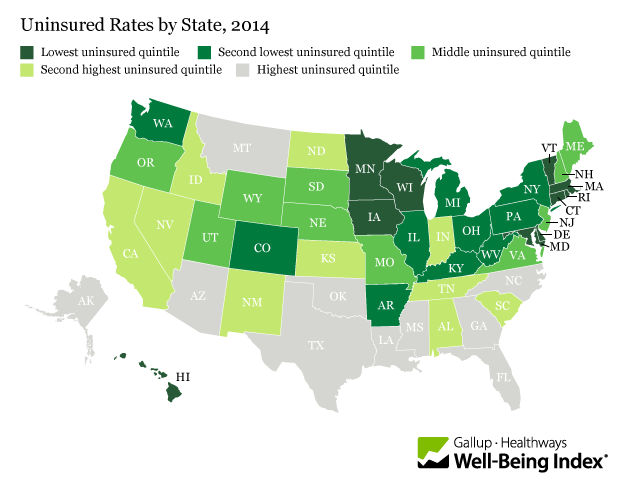
Gallup: More in NC insured, but gains are small

North Carolina went from having just over 20 percent of its citizens uninsured in 2013 to 16 percent last year,  once the Affordable Care Act started offering subsidies to help people afford premiums, Gallup reported Tuesday.

But states that accepted federal money to expand Medicaid for the poorest adults saw bigger gains in coverage, according to the latest report from the Gallup-Healthways Well-Being Index,  which polls a random sampling of adults across the country. The national uninsured rate went from 17.3 percent to 13.8 percent, the lowest in the seven years of the well-being poll.

"Collectively, the uninsured rate in states that have chosen to expand Medicaid and set up their own state exchanges or partnerships in the health insurance marketplace declined significantly more last year than the rate in states that did not take these steps," Gallup reports. "The uninsured rate declined 4.8 points in the 21 states that implemented both of these measures, compared with a 2.7-point drop across the 29 states that have implemented only one or neither of these actions."

North and South Carolina, along with many Republican-led states, neither set up an insurance exchange nor expanded Medicaid. 

As Rose Hoban with N.C. Health News recently reported, bankers and business leaders have been receptive to the argument that expansion would bring financial benefits to the state,  though the state Chamber of Commerce has taken no position. And a coalition of health and anti-poverty advocates argue that expansion would save lives and create jobs. But state legislative leaders remain wary of the costs and complexities of expansion, and Gov. Pat McCrory has said he'll delay any plans to expand coverage until the U.S. Supreme Court rules on a challenge to the ACA.

Thứ Ba, 24 tháng 2, 2015

The Starbucks Method for Primary Care

Whether you like it or not health care financing is transitioning from payment for discrete services to global payment for value. Whether you agree with this trend, or comprehend its meaning, if it has one, is largely irrelevant in the short term. The government of the United States, the Chamber of Commerce, both political parties, all health care stakeholders, and even your own medical associations are fervently supporting, and actively promoting, paying you for value instead of work.

Value is defined by a set of statistical metrics calculated across the spectrum of services you provide, and some that you don’t. So for example, if Starbucks were to be paid for value, they would get say, $2 for a venti latte, plus a fluctuating amount based on the average temperature of their lattes, the ratio of espresso to milk, the percent of air in the foam, the time from door to latte, etc., over a representative period of say 90 days in year one and maybe 12 months in subsequent years. To enable latte valuation, all espresso machines would be fitted with special monitors interfaced to local cash registers and to centralized centers of value. The exact value-based bonus would be calculated by analyzing the statistical distribution of metrics across all coffee shops in the country, adjusted for regional and demographic variation of their clients.

If Howard Schultz would be notified tomorrow morning of a transition to value-based payment for coffee, he would most likely protest loudly, but at the same time he would find a way to get $10 for his lattes while the coffee debates are raging across the nation. And so would every independent coffee shop still in existence. Health care is of course much more complicated than making espresso drinks, but the principle is the same. Unless you find a way to keep your doors open during bad times, you will not be around to enjoy the fruits of your efforts to bring about the good times. Assuming you wish to continue selling coffee, there are two (legal) options to consider: sell fake lattes for less than $2, like they have in every self-respecting gas station, or do what Howard Schultz would do in a similar situation.

The Howard Schultz option for independent primary care could be summarized as the answer to the following question: what do I need to do in my practice, so that I can collect enough revenue to continue providing the excellent care my patients are accustomed to? Below are some suggestions that may allow you to do just that. You could look at these suggestions as encouragement to sell your soul to the devil, or you could look at them as an optimal way for creating enough breathing room for you, and your patients, until common sense prevails. If you are tempted to dismiss this, in view of the recent (partial) success of grassroots efforts to beat back the ABIM MOC, please keep in mind that by and large those who fought ABIM were board certified physicians in good standing. Fighting for a good cause does not mean that you first have to commit financial and professional suicide.

Beginning on January 1st, 2015, Medicare will be paying physicians for chronic care management (CCM) services, if and only if, a certified EHR is used in the practice. This is the first time Medicare is tying payment for a CPT code, to the use of specific technology, and it may very well be a harbinger of things to come. Medicare is essentially stating that unless you buy and use a government certified EHR (not just any EHR), it will refuse to pay you for any work (other than face to face visits) that you do for your chronically ill patients. It is fascinating to note that Medicare acknowledges that certified EHRs cannot help much with CCM services, and you may need other software products for this purpose. Nevertheless you must also purchase a certified EHR.

On February 12th, 2015 the Center for Medicare & Medicaid Innovation Center (CMMI) has announced a new payment model for cancer care, the Oncology Care Model (OCM), modeled after the CCM, but paying four times as much to oncology practices only. The OCM is going to enter pilot phase in 2016, and chances are it will be elevated to an official CPT code shortly thereafter.  Taking the CCM one step further, the oncology care management fee will be paid exclusively to practices that attest to currently mandated meaningful use levels (Stage 2 for now), although meaningful use has practically nothing to do with oncology care.

It is not implausible to assume that these are just the first steps in making collection and dissemination of clinical data, along with kickbacks to the tech and certification industry, a condition for practicing medicine. If you think you can somehow “escape” these mandates by dropping public insurance plans, you should note that the OCM pilot mandates participation of commercial insurance plans in this form of payment. Unlike the puny meaningful use incentives/penalties, both CCM and OCM fees can add up to large amounts of recurring revenues for a complex set of services. If you don’t have a certified EHR, your choices are to either continue performing these services for free, or cease to provide them altogether. Strangely enough, nobody seems to question the legality of such scheme.

Bottom Line

Go ahead and get yourself a (cheap) certified EHR, and use it sparingly if you so desire. Make sure you know how to get all the data out of the EHR, because chances are you will want to dump it when things get better. Keep in mind that even under the best case scenario, technology will not improve overnight. It takes several years to build (or refurbish) a good EHR, and EHR vendors are now operating within a regulatory pay for performance mentality, i.e. studying for the (certification) test and cheating to survive. Even if Medicare drops its ill-conceived meaningful use program tomorrow, it will take time to return to a competitive culture of excellence and customer service, yielding beneficial technology tools for your practice.

It is not likely that value-based payment models will disappear, or be reconfigured to measure benefits to your patients, because there are hundreds of billions of dollars in shareholders profits, and fabulous round trips to Davos, riding on this one simple innovation. It is equally unlikely that physician payments will grow in the near future, and there is every reason to assume that payments will decline sharply, as the system adjusts itself to serving increasing numbers of underinsured poor people. It will be very important for you to strike an optimal balance between keeping your costs down, and increasing your value-based revenues.

Finally, for those insisting that their practice is doing just fine without all this unsolicited advice, this may be so for now. And for a few fortunate physicians, it may be so for long enough to reach comfortable retirement. Perhaps a handful more would be able to extricate themselves from this mess by catering exclusively to the few that need not concern themselves with costs of anything.  Everybody else should find a way to collect $10 for their lattes.

Thứ Sáu, 20 tháng 2, 2015

Managed care groups push N.C. Medicaid reform

A coalition of insurance companies and managed care providers recently launched N.C. Medicaid Choice to lobby for change in the way the state administers the program.

"The Coalition supports legislation that shifts financial risk away from taxpayers by allowing traditional managed care plans, as well as plans offered by health care providers, to compete in the North Carolina Medicaid market," says an announcement posted Feb. 10.

Griffin
Aetna, Amerigroup, AmeriHealth Caritas, UnitedHealth Group and WellCare are the founding members. They've hired Taylor Griffin, a political consultant who ran for Congress in the 2014 GOP primary, as point person for the campaign. Griffin, an Appalachian State alum, worked for Sen. Jesse Helms and President George W. Bush before making his own bid for office (he lost to Walter Jones).

Republican leaders of the state House and Senate have talked about the need to reform Medicaid, which has a history of cost overruns, but haven't agreed on a strategy.  Griffin said Thursday his coalition supports the Medicaid Modernization bill,  which would let groups like the ones he represents compete with accountable care organizations run by doctors or hospital, over the Partnership for a Healthy North Carolina bill that turns Medicaid over to only the provider-led groups. 

Both involve the state paying a per-patient fee to groups that take the responsibility for providing care and controlling costs; they turn profit if they come in under budget or take the loss if they run over.  Both, says Griffin, provide incentives to push the kind of preventive care that not only cuts costs but improves lives -- for instance, prenatal care, timely screenings and healthy lifestyle changes. Allowing the established for-profit firms to compete will lead to bigger savings and a quicker roll-out, Griffin said.

A news analysis that ran in the Observer this week noted that in some Republican circles, "Medicaid reform" has become a euphemism for taking federal "Obamacare" money to expand coverage for low-income adults. Griffin said his group is taking no stand on Medicaid expansion in North Carolina. For them, reform is about fixing with the system that's in place, not making more people eligible.

Thứ Năm, 19 tháng 2, 2015

ACA numbers: What's squishy, what's solid?

Early tallies of 2015 participation in the Affordable Care Act exchange are bound to raise follow-up questions,  not only among those who doubt anything President Obama says but those trying to sort out the nuances of a complex system.

The White House was eager to announce a preliminary estimate of 11.4 million sign-ups nationwide.  That includes totals from the 37 states that use the federal marketplace as well as  "preliminary analyses"  of data from state-run markets.  Federal officials say that number is 10 percent over the White House target, with numbers that jumped significantly in the final week.
White House graphic touting tally

As indicated by the  "preliminary" label,  that tally is bound to change.  Some states that run their own markets have granted extensions to the Feb. 15 deadline because of winter storms or system glitches.  Some who hit snarls in the federal exchange on the final weekend got an extra week to finish enrolling.

The tally includes people who selected plans but won't actually pay the premiums.  Kevin Counihan,  CEO of the federal marketplace,  predicts that about 87 percent of enrollments will translate to actual coverage.  That comes to about 9.9 million people.  Obamacare critic Avik Roy noted that 2014 ACA retention translated to 84 percent,  "fairly similar to (the rate) experienced by private insurers in the conventional ... insurance market."

The feds also released totals for the states using HealthCare.gov and major cities within those markets  (read that report here).  We don't yet have a breakdown of new plans vs. renewals for the states,  though Counihan said about 8.6 million of the 11.4 million nationwide,  or 75 percent,  were renewals.  Nor do we have a final count on how many got subsidies,  though a Feb. 9 report pegged North Carolina's total at 92 percent.

Katherine Restrepo,  health analyst for the John Locke Foundation,  notes that while that percentage may be accurate it can be misleading.  Those at the high end of eligibility (up to $95,400 for a family of four) get small tax credits that do little to lower costs, she says.

Roy contends that the White House tally is "deceptive" because it includes an unknown number of people who already had insurance and switched. It's true that the totals don't distinguish between those who had insurance and those who didn't,  though I'm not convinced that the White House and "friendly media outlets" have claimed otherwise.

Finally,  reader Bryan Griffith correctly called me out for not including any specifics in a recent article citing a surge of last-minute enrollments in Charlotte.  Here's what the latest report shows:  The Charlotte metro area got almost 17,000 sign-ups between Feb. 6 and Feb. 15,  or about 12 percent of the total enrollment logged during the 13-week enrollment period.

Thứ Ba, 17 tháng 2, 2015

Unanimous vote to expand N.C. Medicaid? Well ...

Jeff Jackson,  a Democratic state senator representing Mecklenburg's District 37,  knows how to have fun with a snow day.

This morning he posted on Facebook that "Due to inclement weather,  I appear to be the only non-security person in the General Assembly this morning.  I feel like I should hurry up and pass Medicaid expansion.  Anything else while I've got the place to myself?


His constituents  --  or at least his Facebook friends -- got a kick out of that,  with more than 100 comments and 500 likes by 9:30 a.m.  He got a long list of requests,  from raising teacher pay to banning puppy mills and legalizing marijuana.

Around 8:30 a.m.,  Jackson started tallying his accomplishments:

Just came back from the Senate chamber. All votes were unanimous.
Medicaid = expanded. Teachers = paid. Film = jobs. What's next?
This is going to be like "Night at the Museum" except at the end we'll have a stronger middle class.

Sen. Jeff Tarte, a Mecklenburg Republican, later posted that he and several GOP colleagues were there working as well.   "Classic example of Democrats 'misrepresenting the facts,' "  Tarte sniffed  before tipping his hand with an "LOL" and an invitation for Jackson to join him for dinner.

By that time the #JustOneLegislator winter fantasy had gone viral.  Mutual Facebook friend Laura Hehn had a suggestion  --  "Work together and make some positive changes!"  --  and even offered a couple of new hashtags: #JustTwoLegislators or #JustTheJeffs.

Losing health benefits? Study blames recession

If your employer provides health insurance,  you're probably paying more for less  --  and wondering who's to blame.  The Affordable Care Act has contributed to rising costs by mandating certain types of coverage,  allowing many adult children to stay on parents'  policies and levying a 2018 tax on high-cost  "Cadillac plans."

But the trend toward reducing benefits and dropping health insurance altogether was in full swing before the act kicked in this year, according to a recent analysis by the University of Minnesota’s State Health Access Data Assistance Center and the Robert Wood Johnson Foundation.

Before to the recession, the research shows that employer coverage was fairly stable.  Between 2004-05 and 2008-09,  for instance,  North and South Carolina,  like most of the country,  saw no significant change in the percent of employers offering health insurance.  But the rates dropped from 2008-09,  the start of the recession,  to 2012-13.  In North Carolina it went from 53 percent to 47 percent,  and in South Carolina from 54 percent to 47 percent.  Most of that decline has come from companies with fewer than 50 employees.


That's consistent with what I've heard.  For instance,  I wrote last fall about Charlotte's Blue Max Materials,  a small employer,  dropping health insurance in the face of rising costs.  Meanwhile,  the owner of Stafford Cutting Dies bumped up deductibles dramatically to cope with skyrocketing costs for a small-business policy.


“Most Americans still get health insurance through their jobs, but this has been declining for more than a decade,” said Katherine Hempstead, who directs coverage issues at the foundation. “It will be interesting to see how that trend evolves now that there are more opportunities for coverage through the individual market and Medicaid.”

The report includes detailed breakdowns for each state.