Hiển thị các bài đăng có nhãn Medicaid expansion. Hiển thị tất cả bài đăng

Thứ Tư, 25 tháng 2, 2015

Gallup: More in NC insured, but gains are small

North Carolina went from having just over 20 percent of its citizens uninsured in 2013 to 16 percent last year,  once the Affordable Care Act started offering subsidies to help people afford premiums, Gallup reported Tuesday.

But states that accepted federal money to expand Medicaid for the poorest adults saw bigger gains in coverage, according to the latest report from the Gallup-Healthways Well-Being Index,  which polls a random sampling of adults across the country. The national uninsured rate went from 17.3 percent to 13.8 percent, the lowest in the seven years of the well-being poll.

"Collectively, the uninsured rate in states that have chosen to expand Medicaid and set up their own state exchanges or partnerships in the health insurance marketplace declined significantly more last year than the rate in states that did not take these steps," Gallup reports. "The uninsured rate declined 4.8 points in the 21 states that implemented both of these measures, compared with a 2.7-point drop across the 29 states that have implemented only one or neither of these actions."
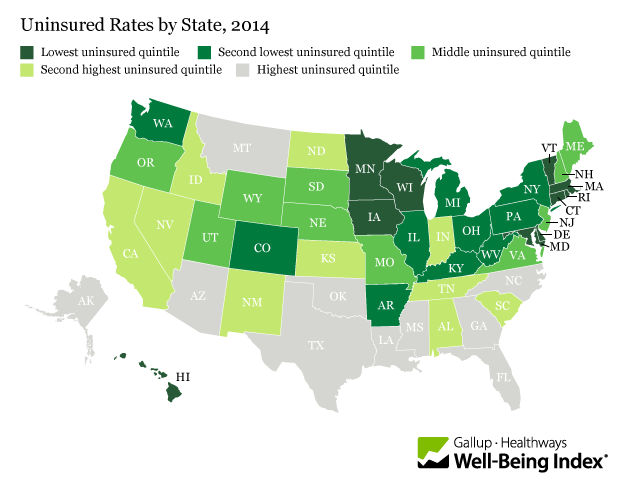
North and South Carolina, along with many Republican-led states, neither set up an insurance exchange nor expanded Medicaid. 

As Rose Hoban with N.C. Health News recently reported, bankers and business leaders have been receptive to the argument that expansion would bring financial benefits to the state,  though the state Chamber of Commerce has taken no position. And a coalition of health and anti-poverty advocates argue that expansion would save lives and create jobs. But state legislative leaders remain wary of the costs and complexities of expansion, and Gov. Pat McCrory has said he'll delay any plans to expand coverage until the U.S. Supreme Court rules on a challenge to the ACA.

Thứ Ba, 17 tháng 2, 2015

Unanimous vote to expand N.C. Medicaid? Well ...

Jeff Jackson,  a Democratic state senator representing Mecklenburg's District 37,  knows how to have fun with a snow day.

This morning he posted on Facebook that "Due to inclement weather,  I appear to be the only non-security person in the General Assembly this morning.  I feel like I should hurry up and pass Medicaid expansion.  Anything else while I've got the place to myself?


His constituents  --  or at least his Facebook friends -- got a kick out of that,  with more than 100 comments and 500 likes by 9:30 a.m.  He got a long list of requests,  from raising teacher pay to banning puppy mills and legalizing marijuana.

Around 8:30 a.m.,  Jackson started tallying his accomplishments:

Just came back from the Senate chamber. All votes were unanimous.
Medicaid = expanded. Teachers = paid. Film = jobs. What's next?
This is going to be like "Night at the Museum" except at the end we'll have a stronger middle class.

Sen. Jeff Tarte, a Mecklenburg Republican, later posted that he and several GOP colleagues were there working as well.   "Classic example of Democrats 'misrepresenting the facts,' "  Tarte sniffed  before tipping his hand with an "LOL" and an invitation for Jackson to join him for dinner.

By that time the #JustOneLegislator winter fantasy had gone viral.  Mutual Facebook friend Laura Hehn had a suggestion  --  "Work together and make some positive changes!"  --  and even offered a couple of new hashtags: #JustTwoLegislators or #JustTheJeffs.

Thứ Ba, 10 tháng 2, 2015

Health activist moves from Obama's home to Tar Heel state

One of the best-known health care activists from President Obama's home state has recently moved to North Carolina.

Jim Duffett,  longtime director of the Illinois Campaign for Better Health Care,  relocated to Chapel Hill in August,  drawn by milder winters and job opportunities for his wife,  an oncology nurse.  In Illinois he spent 30 years working for affordable care and patient rights,  eventually building a coalition of 300 groups representing health care,  faith,  labor and various communities.
Duffett

"One fond memory is having had the honor of working with Obama on health care reform in Illinois during Obama's years as a (state) senator,  and now,  'knowing he is the president and still knows you,'  "  Duffett said in an interview with The  (Champaign)  News-Gazette.

Duffett,  a proponent of a single-payer insurance system,  has connected with the NAACP-led Forward Together Moral Movement and is looking for work in advocacy here.  He says he's still getting up to speed on North Carolina's health care scene,  but sees some similarities with his old turf.  Both states have powerful political opposition to Medicaid expansion,  he said,  and Illinois'  2013 approval was hard-fought and narrowly won.  In North Carolina,  he says,  he hopes to build alliances with some of the hospital,  medical and business interests that united with more traditional anti-poverty groups in Illinois.  "There's definitely going to have to be a bit more base-building,"  he said,  though the Moral Monday protests  "are definitely galvanizing folks."


Chủ Nhật, 8 tháng 2, 2015

Single white Southerners: ACA benefits may await

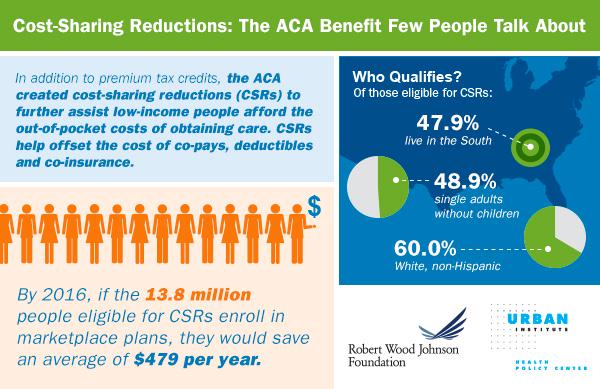
People who are eligible for aid paying out-of-pocket medical costs are most likely to be white, single and living in the South,  according to a new report from the Robert Wood Johnson Foundation and the Urban Institute.

Most people know that the Affordable Care Act provides tax credits  (aka subsidies)  to help low- and moderate-income people buy health insurance.  Less known,  the authors say,  is that people earning up to 200 percent of the federal poverty level  ($29,175 for a single person)  can also get help paying out-of-pocket expenses,  a major concern in an era of high-deductible policies.

"This benefit seems to fall off the radar sometimes,"  said Katherine Hempstead,  director of coverage for the Johnson foundation.  People need to choose a silver plan to qualify for that help, she added.  Those who choose a bronze plan for the lower premiums may end up worse off when they're hit with higher out-of-pocket bills.

The study looks at who is expected to fall into those income ranges in 2016,  though it's obviously timed to remind people about enrollment before the Feb. 15 deadline for 2015 sign-ups.  The authors broke the country into four regions and found that almost half of the eligible people live in the South  (a zone that includes such states as Texas,  Louisiana and Oklahoma,  as well the Southeast).

That's probably because many of those states,  including North and South Carolina,  haven't accepted federal money to expanded Medicaid.  In states that did,  people who fall below 138 percent of poverty qualify for Medicaid.  In non-expansion states,  those between 100 and 138 percent qualify for aid on the exchange.  Many who make less than the poverty level fall into the Medicaid gap and can't afford insurance.

Single people without children accounted for the biggest block by family status  (48.9 percent),  and non-Hispanic white people made up 60 percent of the eligible people.

The study doesn't account for how many people within the income brackets may have other types of  insurance and how many are already be getting the subsidies.

Thứ Sáu, 6 tháng 2, 2015

NC Medicaid battle: Hard numbers and human stories

The groups fighting for North Carolina to expand Medicaid this year are taking a two-pronged approach.

In news conferences in Charlotte and Raleigh this week,  the N.C. Medicaid Expansion Coalition urged people to share their stories at NCLeftMeOut.org.  They're looking for personal tales from people like Charlotte's Dana Wilson,  whose multiple sclerosis limits her to working a few hours a week at an antique shop.  Wilson doesn't earn enough to qualify for subsidized health insurance and isn't eligible for Medicaid.

Charlotte news conference

But the coalition,  led by Action NC and Progress NC,  is also taking a more hard-nosed approach, focusing on jobs and tax revenue that would be generated by accepting the federal money to expand Medicaid coverage.

A recent report by George Washington University's Milken Institute School of Public Health,  commissioned by the Cone Health Foundation and the Kate B. Reynolds Charitable Trust,  projects that if state lawmakers were to approve expansion this year,  the decision would generate about 43,000 jobs by 2020.  About half would be in health care,  the report says,  with the rest spread among sectors ranging from construction to retail "as health care workers use new income to pay their mortgages, buy groceries, pay taxes and so on."

"At county levels, if Medicaid is not expanded by 2016, Mecklenburg and Wake Counties would create about 4,500 fewer jobs each by 2020,"  the report says.  "Mecklenburg County’s total economy (gross county product) from 2016 to 2020 would be almost $1 billion lower."


"Lawmakers like to talk about fiscal responsibility,"  Wilson said in Charlotte Thursday.  "It's just common sense."


The Affordable Care Act includes money to expand Medicaid in all states  --  and levies taxes that everyone is paying,  regardless of whether the state accepts the money or not.  A handful of Republican-led states that initially said no have gotten permission to craft their own version of coverage.  Indiana was the most recent in late January,   and N.C. Gov. Pat McCrory has signaled some interest in crafting a North Carolina plan.

"As we review continue to review health care options for the uninsured,  we are exploring North Carolina-based options that will help those who can't help themselves, and encourage those who can,"  McCrory said in Wednesday's State of the State address.  "If we bring a proposal to cover the uninsured, it will protect North Carolina taxpayers. And any plan will require personal and financial responsibility from those who would be covered."


Read more here: http://www.charlotteobserver.com/2015/02/04/5494786/text-of-nc-gov-mccrorys-state.html#storylink=cpy
As the pro-expansion advocates noted,  that's still far from a specific plan.  And there's still little sign that Senate President Pro Tem Phil Berger or newly elected House Speaker Tim Moore are on board for any kind of expanded coverage.