North Carolina went from having just over 20 percent of its citizens uninsured in 2013 to 16 percent last year, once the Affordable Care Act started offering subsidies to help people afford premiums, Gallup reported Tuesday.
But states that accepted federal money to expand Medicaid for the poorest adults saw bigger gains in coverage, according to the latest report from the Gallup-Healthways Well-Being Index, which polls a random sampling of adults across the country. The national uninsured rate went from 17.3 percent to 13.8 percent, the lowest in the seven years of the well-being poll.
"Collectively, the uninsured rate in states that have chosen to expand Medicaid and set up their own state exchanges or partnerships in the health insurance marketplace declined significantly more last year than the rate in states that did not take these steps," Gallup reports. "The uninsured rate declined 4.8 points in the 21 states that implemented both of these measures, compared with a 2.7-point drop across the 29 states that have implemented only one or neither of these actions."
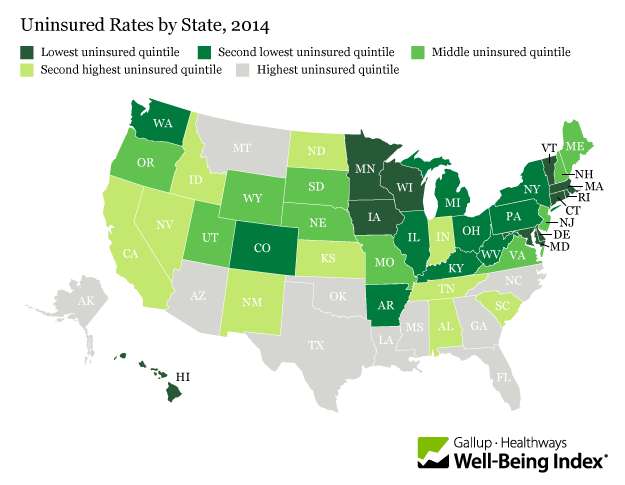
North and South Carolina, along with many Republican-led states, neither set up an insurance exchange nor expanded Medicaid.
As Rose Hoban with N.C. Health News recently reported, bankers and business leaders have been receptive to the argument that expansion would bring financial benefits to the state, though the state Chamber of Commerce has taken no position. And a coalition of health and anti-poverty advocates argue that expansion would save lives and create jobs. But state legislative leaders remain wary of the costs and complexities of expansion, and Gov. Pat McCrory has said he'll delay any plans to expand coverage until the U.S. Supreme Court rules on a challenge to the ACA.
Hiển thị các bài đăng có nhãn ACA. Hiển thị tất cả bài đăng
Thứ Tư, 25 tháng 2, 2015
Thứ Năm, 19 tháng 2, 2015
ACA numbers: What's squishy, what's solid?
Early tallies of 2015 participation in the Affordable Care Act exchange are bound to raise follow-up questions, not only among those who doubt anything President Obama says but those trying to sort out the nuances of a complex system.
The White House was eager to announce a preliminary estimate of 11.4 million sign-ups nationwide. That includes totals from the 37 states that use the federal marketplace as well as "preliminary analyses" of data from state-run markets. Federal officials say that number is 10 percent over the White House target, with numbers that jumped significantly in the final week.
As indicated by the "preliminary" label, that tally is bound to change. Some states that run their own markets have granted extensions to the Feb. 15 deadline because of winter storms or system glitches. Some who hit snarls in the federal exchange on the final weekend got an extra week to finish enrolling.
The tally includes people who selected plans but won't actually pay the premiums. Kevin Counihan, CEO of the federal marketplace, predicts that about 87 percent of enrollments will translate to actual coverage. That comes to about 9.9 million people. Obamacare critic Avik Roy noted that 2014 ACA retention translated to 84 percent, "fairly similar to (the rate) experienced by private insurers in the conventional ... insurance market."
The feds also released totals for the states using HealthCare.gov and major cities within those markets (read that report here). We don't yet have a breakdown of new plans vs. renewals for the states, though Counihan said about 8.6 million of the 11.4 million nationwide, or 75 percent, were renewals. Nor do we have a final count on how many got subsidies, though a Feb. 9 report pegged North Carolina's total at 92 percent.
Katherine Restrepo, health analyst for the John Locke Foundation, notes that while that percentage may be accurate it can be misleading. Those at the high end of eligibility (up to $95,400 for a family of four) get small tax credits that do little to lower costs, she says.
Roy contends that the White House tally is "deceptive" because it includes an unknown number of people who already had insurance and switched. It's true that the totals don't distinguish between those who had insurance and those who didn't, though I'm not convinced that the White House and "friendly media outlets" have claimed otherwise.
Finally, reader Bryan Griffith correctly called me out for not including any specifics in a recent article citing a surge of last-minute enrollments in Charlotte. Here's what the latest report shows: The Charlotte metro area got almost 17,000 sign-ups between Feb. 6 and Feb. 15, or about 12 percent of the total enrollment logged during the 13-week enrollment period.
The White House was eager to announce a preliminary estimate of 11.4 million sign-ups nationwide. That includes totals from the 37 states that use the federal marketplace as well as "preliminary analyses" of data from state-run markets. Federal officials say that number is 10 percent over the White House target, with numbers that jumped significantly in the final week.
| White House graphic touting tally |
As indicated by the "preliminary" label, that tally is bound to change. Some states that run their own markets have granted extensions to the Feb. 15 deadline because of winter storms or system glitches. Some who hit snarls in the federal exchange on the final weekend got an extra week to finish enrolling.
The tally includes people who selected plans but won't actually pay the premiums. Kevin Counihan, CEO of the federal marketplace, predicts that about 87 percent of enrollments will translate to actual coverage. That comes to about 9.9 million people. Obamacare critic Avik Roy noted that 2014 ACA retention translated to 84 percent, "fairly similar to (the rate) experienced by private insurers in the conventional ... insurance market."
The feds also released totals for the states using HealthCare.gov and major cities within those markets (read that report here). We don't yet have a breakdown of new plans vs. renewals for the states, though Counihan said about 8.6 million of the 11.4 million nationwide, or 75 percent, were renewals. Nor do we have a final count on how many got subsidies, though a Feb. 9 report pegged North Carolina's total at 92 percent.
Katherine Restrepo, health analyst for the John Locke Foundation, notes that while that percentage may be accurate it can be misleading. Those at the high end of eligibility (up to $95,400 for a family of four) get small tax credits that do little to lower costs, she says.
Roy contends that the White House tally is "deceptive" because it includes an unknown number of people who already had insurance and switched. It's true that the totals don't distinguish between those who had insurance and those who didn't, though I'm not convinced that the White House and "friendly media outlets" have claimed otherwise.
Finally, reader Bryan Griffith correctly called me out for not including any specifics in a recent article citing a surge of last-minute enrollments in Charlotte. Here's what the latest report shows: The Charlotte metro area got almost 17,000 sign-ups between Feb. 6 and Feb. 15, or about 12 percent of the total enrollment logged during the 13-week enrollment period.
Thứ Sáu, 13 tháng 2, 2015
So you got insurance. Will it help?
As the 2015 push for health-insurance enrollment winds down, the next challenge grows ever clearer: Insured people who can't afford medical care.
The New York Times Sunday Review carried an article titled "Insured, but Not Covered." Reporter Elisabeth Rosenthal explores trends in insurance and health care that are leaving people with insurance unable to find doctors or pay bills.
Her conclusion: While the Affordable Care Act has brought coverage to roughly 10 million Americans and eliminated "some of the more egregious practices of the American health insurance system that left patients bankrupt or losing homes to pay bills," the law has also adopted policies that "may in some ways be undermining its signature promise: health care that is accessible and affordable for all."
A key culprit is the boom in high-deductible policies, which allow employers and private buyers to reduce premiums by agreeing to much higher out-of-pocket costs.
For instance, HealthSherpa recently sent along an analysis of 14,000 North Carolina health insurance purchases made on the company's web site, which provides an alternative path for buying subsidized plans on the ACA exchange. Those buyers had an average household income of about $20,400 and bought policies that averaged $70 a month for the buyer, with the government kicking in an average of $381 a month.
But the average deductible per enrollee was $3,969 and the average out-of-pocket max was $5,745. Can you imagine anyone making less than $21,000 a year being able to save $4,000 to $6,000 to cover those costs? Reality is, even paying a couple of hundred dollars may be daunting enough to discourage people from going to the doctor's office.
A recent report from The Commonwealth Fund showed that the number of people skipping care because of costs declined in 2014, the first time since the question was added to the fund's health insurance survey in 2003. But while the numbers fell significantly compared with 2013, the year before the ACA took effect, the report estimates that 66 million Americans, or 36 percent of adults, still skipped an office visit, test, treatment or prescription because they couldn't afford it.
The New York Times Sunday Review carried an article titled "Insured, but Not Covered." Reporter Elisabeth Rosenthal explores trends in insurance and health care that are leaving people with insurance unable to find doctors or pay bills.
Her conclusion: While the Affordable Care Act has brought coverage to roughly 10 million Americans and eliminated "some of the more egregious practices of the American health insurance system that left patients bankrupt or losing homes to pay bills," the law has also adopted policies that "may in some ways be undermining its signature promise: health care that is accessible and affordable for all."
A key culprit is the boom in high-deductible policies, which allow employers and private buyers to reduce premiums by agreeing to much higher out-of-pocket costs.
For instance, HealthSherpa recently sent along an analysis of 14,000 North Carolina health insurance purchases made on the company's web site, which provides an alternative path for buying subsidized plans on the ACA exchange. Those buyers had an average household income of about $20,400 and bought policies that averaged $70 a month for the buyer, with the government kicking in an average of $381 a month.
But the average deductible per enrollee was $3,969 and the average out-of-pocket max was $5,745. Can you imagine anyone making less than $21,000 a year being able to save $4,000 to $6,000 to cover those costs? Reality is, even paying a couple of hundred dollars may be daunting enough to discourage people from going to the doctor's office.
A recent report from The Commonwealth Fund showed that the number of people skipping care because of costs declined in 2014, the first time since the question was added to the fund's health insurance survey in 2003. But while the numbers fell significantly compared with 2013, the year before the ACA took effect, the report estimates that 66 million Americans, or 36 percent of adults, still skipped an office visit, test, treatment or prescription because they couldn't afford it.
Chủ Nhật, 8 tháng 2, 2015
Single white Southerners: ACA benefits may await
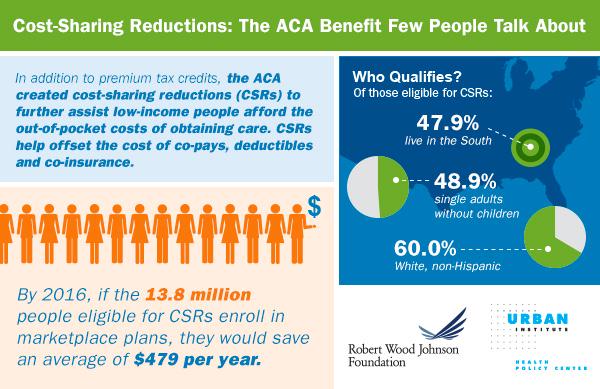
People who are eligible for aid paying out-of-pocket medical costs are most likely to be white, single and living in the South, according to a new report from the Robert Wood Johnson Foundation and the Urban Institute.
Most people know that the Affordable Care Act provides tax credits (aka subsidies) to help low- and moderate-income people buy health insurance. Less known, the authors say, is that people earning up to 200 percent of the federal poverty level ($29,175 for a single person) can also get help paying out-of-pocket expenses, a major concern in an era of high-deductible policies.
"This benefit seems to fall off the radar sometimes," said Katherine Hempstead, director of coverage for the Johnson foundation. People need to choose a silver plan to qualify for that help, she added. Those who choose a bronze plan for the lower premiums may end up worse off when they're hit with higher out-of-pocket bills.
The study looks at who is expected to fall into those income ranges in 2016, though it's obviously timed to remind people about enrollment before the Feb. 15 deadline for 2015 sign-ups. The authors broke the country into four regions and found that almost half of the eligible people live in the South (a zone that includes such states as Texas, Louisiana and Oklahoma, as well the Southeast).
That's probably because many of those states, including North and South Carolina, haven't accepted federal money to expanded Medicaid. In states that did, people who fall below 138 percent of poverty qualify for Medicaid. In non-expansion states, those between 100 and 138 percent qualify for aid on the exchange. Many who make less than the poverty level fall into the Medicaid gap and can't afford insurance.
Single people without children accounted for the biggest block by family status (48.9 percent), and non-Hispanic white people made up 60 percent of the eligible people.
The study doesn't account for how many people within the income brackets may have other types of insurance and how many are already be getting the subsidies.
Most people know that the Affordable Care Act provides tax credits (aka subsidies) to help low- and moderate-income people buy health insurance. Less known, the authors say, is that people earning up to 200 percent of the federal poverty level ($29,175 for a single person) can also get help paying out-of-pocket expenses, a major concern in an era of high-deductible policies.
"This benefit seems to fall off the radar sometimes," said Katherine Hempstead, director of coverage for the Johnson foundation. People need to choose a silver plan to qualify for that help, she added. Those who choose a bronze plan for the lower premiums may end up worse off when they're hit with higher out-of-pocket bills.
The study looks at who is expected to fall into those income ranges in 2016, though it's obviously timed to remind people about enrollment before the Feb. 15 deadline for 2015 sign-ups. The authors broke the country into four regions and found that almost half of the eligible people live in the South (a zone that includes such states as Texas, Louisiana and Oklahoma, as well the Southeast).
That's probably because many of those states, including North and South Carolina, haven't accepted federal money to expanded Medicaid. In states that did, people who fall below 138 percent of poverty qualify for Medicaid. In non-expansion states, those between 100 and 138 percent qualify for aid on the exchange. Many who make less than the poverty level fall into the Medicaid gap and can't afford insurance.
Single people without children accounted for the biggest block by family status (48.9 percent), and non-Hispanic white people made up 60 percent of the eligible people.
The study doesn't account for how many people within the income brackets may have other types of insurance and how many are already be getting the subsidies.
Nhãn:
ACA,
Affordable Care Act,
high deductible,
Medicaid expansion,
Medicaid gap,
North Carolina,
Obamacare,
out of pocket costs,
Robert Wood Johnson Foundation,
Urban Institute
Thứ Năm, 5 tháng 2, 2015
Separated, uninsured and out of luck?
A reader who's in the process of divorce emailed to ask whether there's any way he can get help paying for health insurance this year.
He works part time and says he'd spend half his take-home pay buying a private policy. His wife makes a lot more, and the reader says he was told that because they're not divorced, his household income includes her pay, which puts him out of range for tax credits on the Affordable Care Act exchange.
"I was just wondering if I’m screwed until I am officially divorced," he said.
I thought I knew the answer (yes, but you can apply once the divorce goes through), but Madison Hardee of Legal Services of Southern Piedmont says it's not that simple.
Read more here: http://www.charlotteobserver.com/2015/01/23/5466303/obamacare-enrollment-grows-in.html#.VNKaf2jF_GE#storylink=cpy
He works part time and says he'd spend half his take-home pay buying a private policy. His wife makes a lot more, and the reader says he was told that because they're not divorced, his household income includes her pay, which puts him out of range for tax credits on the Affordable Care Act exchange.
| Image: wikihow.com |
I thought I knew the answer (yes, but you can apply once the divorce goes through), but Madison Hardee of Legal Services of Southern Piedmont says it's not that simple.
"Marketplace eligibility for couples who are married but separated is complicated," she wrote. "You are correct that the marketplace asks consumers for their current marital status. However, at tax filing, the IRS will consider the marital status on December 31st of the tax year. For example, if a consumer is currently married and then gets divorced in July 2015, the IRS will consider that person unmarried for the entire 2015 tax year."
So if the reader, who asked that I not share his name, applies now, he'll presumably be denied any financial aid based on the combined income. And if he doesn't enroll in a plan before the Feb. 15 deadline, he won't automatically be eligible for special enrollment based on the divorce. But if he enrolls now, he can go back to HealthCare.gov after the divorce, report the change in income and select a new plan if he qualifies for subsidies, Hardee said.
Hardee is a lawyer who has been trained in ACA enrollment, so she added even more caveats based on special circumstances.
My takeaway: Anyone like this reader, who faces crucial decisions about paying for care, needs to hustle to take advantage of 10 more days of free assistance. Don't ask your neighbor or your aunt or even a reasonably well-informed reporter. Sit down with an expert who can review your individual circumstances and talk you through options.
To get free help in North Carolina, call 855-733-3711 or visit www.getcoveredamerica.org/connector. In South Carolina, call 888-998-4646 or visit www.signupsc.com. Don't dawdle; I'm hearing that appointments are filling up.
You can also call an insurance broker. Or do a walk-in at Get Covered Mecklenburg's last-minute enrollment event from 10 a.m. to 4 p.m. Feb. 14 at the Children and Family Services Center, 601 E. Fourth St.
Just don't kick yourself on Feb. 16 for procrastinating.
Read more here: http://www.charlotteobserver.com/2015/01/23/5466303/obamacare-enrollment-grows-in.html#.VNKaf2jF_GE#storylink=cpy
Thứ Tư, 4 tháng 2, 2015
Can GOP reform Obamacare?
As the Republican-led Congress begins its 2015 "repeal the Affordable Care Act" season, this seems like a good time to loop back to Philip Klein's examination of GOP alternatives for health care.
Tuesday's vote on H.R. 596 is part of an ongoing political drama that has already featured more than 50 house votes to repeal the ACA. But in "Overcoming Obamacare," conservative health writer Klein delves into three long-term conservative strategies to reshape a broken system.
Avik Roy of the Manhattan Institute, a former adviser to the Mitt Romney presidential campaign, is a leading voice in what Klein dubs the reform camp. Roy's plan preserves some elements of the ACA, including the insurance exchange and protections for people with pre-existing conditions.
"Roy's philosophical starting point on the health care issue differs from that of many conservatives in that he has argued in favor of universal coverage, calling it 'a morally worthy goal.' His plan is also based on the assumption that repeal is unlikely," Klein writes.
Roy's reform plan outlines changes that can be made piece by piece, such as eliminating many of the ACA taxes, allowing insurers to charge higher rates for older customers and extending private-insurance exchanges to Medicaid and Medicare. He touts it as a politically feasible strategy that would make insurance cheaper and more appealing for young people while costing taxpayers less than the ACA.
Klein predicts that it's more likely to alienate members of both parties, with Democrats resisting the changes while Republicans "would be expected to embrace the goal of universal coverage" and "cede major ground to Obamacare on taxes, spending and regulations."
Coming soon: A look at the "replace" and "restart" strategies.
Tuesday's vote on H.R. 596 is part of an ongoing political drama that has already featured more than 50 house votes to repeal the ACA. But in "Overcoming Obamacare," conservative health writer Klein delves into three long-term conservative strategies to reshape a broken system.
| Roy |
"Roy's philosophical starting point on the health care issue differs from that of many conservatives in that he has argued in favor of universal coverage, calling it 'a morally worthy goal.' His plan is also based on the assumption that repeal is unlikely," Klein writes.
Roy's reform plan outlines changes that can be made piece by piece, such as eliminating many of the ACA taxes, allowing insurers to charge higher rates for older customers and extending private-insurance exchanges to Medicaid and Medicare. He touts it as a politically feasible strategy that would make insurance cheaper and more appealing for young people while costing taxpayers less than the ACA.
Klein predicts that it's more likely to alienate members of both parties, with Democrats resisting the changes while Republicans "would be expected to embrace the goal of universal coverage" and "cede major ground to Obamacare on taxes, spending and regulations."
Coming soon: A look at the "replace" and "restart" strategies.
Đăng ký:
Bài đăng (Atom)